For roofing estimators and production teams

Plan the roof tear-off around the work and the weather window.

A signed roof is not a production plan. Keep the measured scope, assigned crew, equipment and job hours together, then publish the schedule your foreman is actually going to use.

No long-term contract · Live and set in a week · 14-day free trial

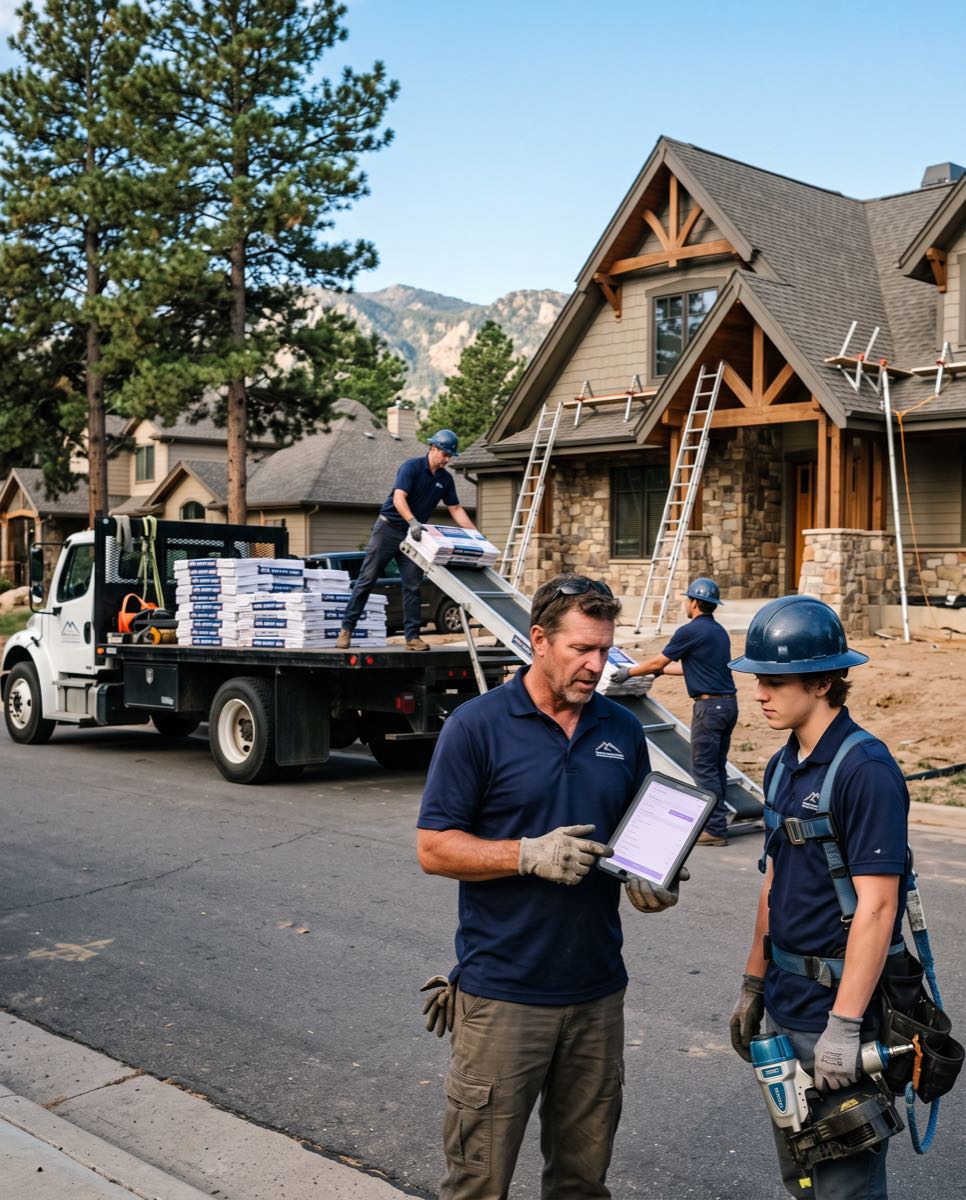
Uniformed roofing crew arriving at a home: workers unloading shingle bundles from the flatbed truck while the foreman reviews the job on a tablet

Built hands-on with working service businesses.

KAN Builders
Attic Projects — Attic & Crawl Space Experts
Alohomora Locksmith & Garage
Jakobsen Water & Fire Restoration
Sky Clean Air
KAN Builders
Attic Projects — Attic & Crawl Space Experts
Alohomora Locksmith & Garage
Jakobsen Water & Fire Restoration
Sky Clean Air

A rain day changes more than one start date.

Moving a roof can affect the crew, equipment and the next customer on the board. A small production office needs to see those commitments together, with enough detail in the bid to know what it is moving.

Use Meni to read the roofing work already recorded. A sample exchange: You: “Which open re-roof estimates need a follow-up?” Meni: “Here are the open estimates to review; I can draft a message for the one you choose.” Your estimator checks the proposal and approves the reply. For weather changes, the production manager still decides which shifts to move and publish.
Roof takeoff

The square count becomes the whole bid.

A roof-area figure alone does not explain the tear-off, accessories or labor that went into the price.

The fix

With Menaia, you build the estimate from measured quantities and scoped catalog items for the replacement work.

Itemized roof scope Keep more than the area in the bid See the estimator
Replacement cost

The shingle price hides the tear-off allowance.

Removal, disposal and installation are folded into a familiar per-square number without a cost check.

The fix

With Menaia, the estimate breakdown exposes material and labor inputs for review before the proposal is issued.

Cost breakdown Check removal as well as replacement See live margin
Production target

“Two days” leaves the crew hours undefined.

A calendar duration does not tell the foreman the total labor allowance for the roof.

The fix

With Menaia, the job carries estimated hours that can be compared with the combined shifts of the roofing crew.

Crew-hour budget A labor target behind the start date See time bonuses
Bid clarity

The homeowner compares roofs by total alone.

Your proposal does not show enough of the replacement scope to explain what the customer is buying.

The fix

With Menaia, a branded proposal presents the selected work and collects the signature on that scope.

Replacement details Give the customer something to compare See proposals
Weather decision

Rain moves the roof, but the old shift survives.

Production revises the board while a crew member still works from yesterday's message.

The fix

With Menaia, the scheduler drafts revised shifts and publishes the confirmed plan to notify assigned people.

Publish the revision One updated assignment for the crew See scheduling
Roofing rewards

The crew sees a payout without the job behind it.

Workers cannot tell whether their reward reflects the hours they contributed to that roof.

The fix

With Menaia, the Wallet records job-linked bonus shares, allocated from the pool by actual hours worked.

Traceable roof bonus Connect the share to the finished work See the Wallet
Office closeout

The dumpster leaves before the invoice is assembled.

Production is done, but the office has to reconstruct the sold roof scope for billing.

The fix

With Menaia, the invoice starts with the estimate, alongside the project record and completion media.

Priced lines retained Close the billing handoff after the roof See invoicing
Production review

A full roof backlog says little about labor margin.

Sold value can grow while replacement jobs consume more crew hours than the bids allowed.

The fix

With Menaia, job estimates and actual shifts provide a labor-variance signal for reviewing the work you completed.

Roof-by-roof hours See the cost signal behind the backlog See cost tracking

Build the bid for the roof you walked.

Take a tear-off and replacement where the estimator has measured the roof and recorded site conditions. Enter those quantities into your catalog, then account for removal, replacement materials, accessories and labor. The calculator turns supplied inputs into pricing; the roof assessment stays with your team.

  • Separate tear-off work from the new roofing materials so removal is visible in the estimate review.
  • Use your labor allowances and applicable factors for the scoped conditions, then check the calculated breakdown.
  • Review disposal and the other agreed work before presenting the final price. Make clear what is included in this bid.
  • Keep site photos with the project to give production context for the scope; the catalog calculator is included from Core upward.
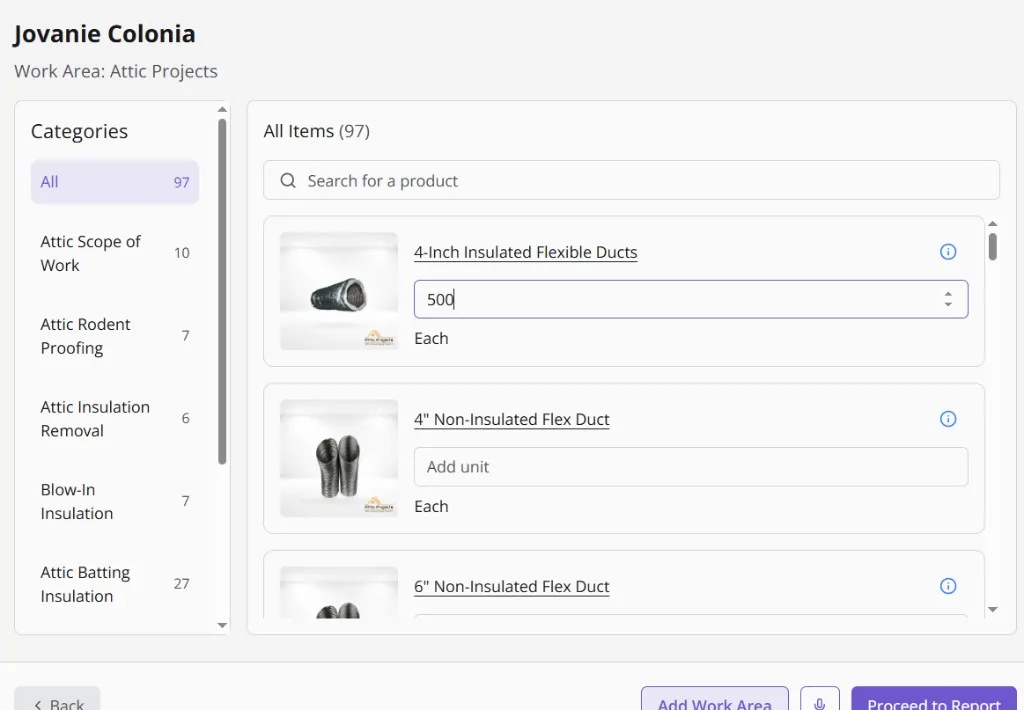
The Menaia estimate calculator for a client: 97 catalog items across categories like attic rodent proofing and blow-in insulation, with a quantity entered on insulated flex duct
Meni is building the estimate
From the price book, on a real job
  • Pulled the price book97 items with your real labor and material costLoaded
  • Priced the linesQuantities in, margin computed per lineMargin visible
  • Drafted the proposalE-signature and the client portal link attachedReady

When rain changes the plan, publish a new one.

Imagine a tear-off planned for tomorrow and a forecast that leads your production manager to postpone it. Review the affected crew and equipment, inspect the next roof on the calendar, and draft the new assignments. Publish only after the team has decided the revised work is feasible.

  • Check person and job views for overlapping commitments before moving the roofing crew.
  • Use the planner to assign people, work items and equipment for each day of the replacement.
  • Put decking conditions and final photos in separate named gallery folders for the office to review.
  • Treat the schedule as your production decision. This workflow does not depend on an automatic weather feed or promise that software chooses a safe start.
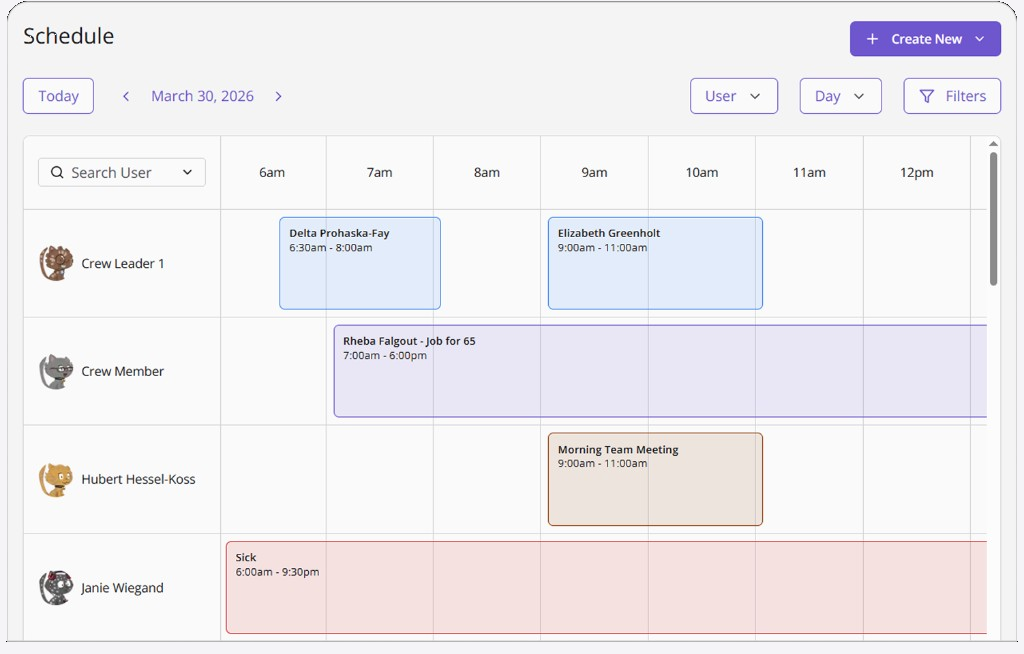
The Menaia schedule in day view: a crew member on Job for 65 from 7:00am to 6:00pm, a morning team meeting, and a sick day, all on one board.
Meni is filling the board
From sold estimate to crew phones
  • Held Thursday 9:00 AMAssessment created from the sold estimateHeld
  • Published the shiftThe crew sees it on their phonesPublished
  • Sent the on-my-way textFrom the schedule, when the tech rollsSent

Tie roofing bonuses to the scoped labor.

Use a labor allowance for the complete roof, then compare it with recorded crew shifts. Hours saved are valued at the branch base rate, and your chosen percentage forms the bonus pool. A weather decision remains a production responsibility, regardless of the time target.

  • Set the estimate around the tear-off, installation and agreed finish work so everyone understands the target.
  • Each roofer's portion follows their hours on the job and appears with the roof job in the Wallet.
  • Review labor variance in context before using a performance result to change the next replacement estimate.
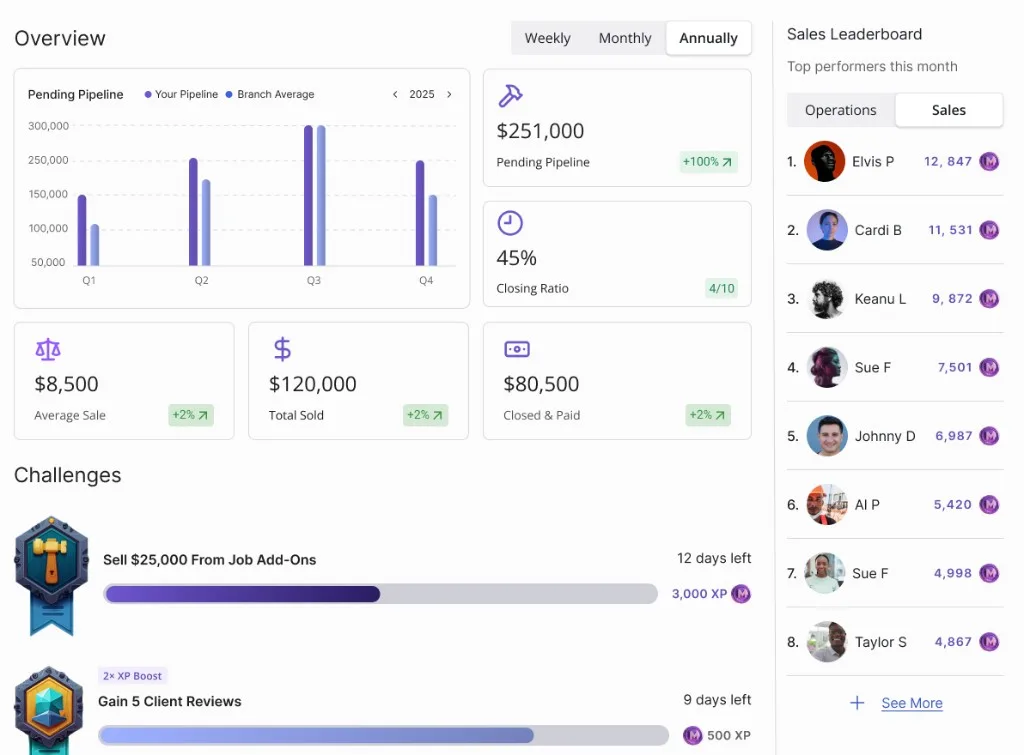
Two active Menaia challenges with badge artwork: Sell $25,000 from job add-ons, 12 days left at 3,000 XP, and Gain 5 client reviews with a 2x XP boost at 500 XP.
Meni is settling the job
Hours to bonuses, no arguments
  • Closed the job under budgetThe crew beat the time budget by 2.5 hoursClosed
  • Paid the bonus into the walletComputed from the hours, visible to the tech+$220.14
  • Posted the winLeaderboard and team feed updatedPosted

Everything else you'd expect, in one place.

Invoicing, payments, project forms, team feeds, and more. Book a demo and we'll walk you through every feature live.

Plans from $134.99 a month. Live in a week. No long-term contract.

Menaia runs on simple terms for roofing businesses: clear plans with seats included, extra users at $35 a month, hands-on onboarding, and no long-term contract. We grow when you grow, so we would rather get you winning first.

The old way
  • Call for pricing, then a quote that changes on the demo
  • $10k+ onboarding and long implementation
  • Locked into a multi-year contract
  • Every new feature is a paid add-on
Menaia
The Menaia way
  • Plans from $134.99/mo with 3 seats included
  • Live and set in a week with hands-on onboarding
  • No long-term contract, stay because it works
  • Clear from day one, no surprise costs

From the crews already running Menaia.

A short customer story and a few words from the Attic Projects team on what changed after the switch.

Customer story"My closing ratio is now no less than 50%" — Eben Woodall, Attic Projects

"Before Menaia, I was able to manage 3 to 4 crews a day. Now I can run anywhere between 10 to 12 in 2 different locations."

Luis Guerra, Operations Manager
Attic Projects

"Payroll used to take me all day long, and now I can be done with my times in about 15 minutes in a day."

Brandon Jones, Office Administrator
Attic Projects

Roofing production questions

Does Menaia measure the roof for my estimator?

The workflow here starts with quantities and conditions supplied by your team. You select catalog items, enter the measured quantities and review the material and labor breakdown. The example is an estimating workflow, not a claim of aerial measurement or automatic roof assessment.

Does a weather forecast automatically move the crew?

Your scheduler decides how to respond to weather. Draft the revised roof shifts, check people and equipment, then publish to notify the assigned crew. The calendar shows the commitments you have recorded; a forecast integration is not part of this example.

How can Meni help with unaccepted roofing bids?

Ask it to identify open estimates and draft follow-up on a selected re-roof proposal. Meni reads the workspace records, so the estimator can review the draft against the quoted roof. Messages wait for human approval rather than committing your crew to a new start date.

Where should the foreman put decking photos?

Upload them to the project gallery and use a folder named for decking conditions. Other folders can hold the initial roof walk and completion photos. The record stays with the job instead of being scattered across the foreman's messages.

Do roof bonuses use days or labor hours?

The calculation uses estimated hours minus actual hours from crew shifts. Multiply saved hours by the branch rate and the pool percentage, then divide the pool according to hours worked. A two-day roof with several workers is not treated as two days of one person's labor.

What should a roofing office budget for software?

Count active estimators, office staff and roofers as seats. Core is $199.99 monthly for five seats, the price book and 6,000 tokens; each additional seat adds $35 a month. Pro includes fifteen seats and 17,000 tokens for $569.99 monthly. Compare expected call and Meni usage as well as headcount.

What can we check during the trial?

The 14-day trial includes 1,500 tokens for Meni and phone tools. Bring a replacement estimate, create a production plan, and review how a revised shift reaches the crew. Guided onboarding is included, so use that time to check your catalog and project-photo organization too.

Bring a roofing week that had to be rearranged.

Use a real tear-off bid and its schedule to check the estimating, planning and crew-notification workflow. Then follow the completed hours through to billing and bonuses.

  • One connected flow from lead to project to performance
  • Live and set in a week with guided onboarding
  • Clear plans, extra users just $35/mo
  • Goals, bonuses, and leaderboards crews can see in real time
Loading available times…

Select a time to continue